
If you seal your driveway at the wrong time of year, it is possible that it will fail before winter arrives.
You’ve finally decided to take care of it. Perhaps a few hairline cracks are beginning to appear, or the surface has transitioned from a deep, rich black to a dull, faded gray, making the entire front of the house appear worn out. In any case, you’ve had enough of ignoring it, and you’re now stuck on a question that appears to have an obvious answer but doesn’t: when do you book the job?
When you search for driveway sealing companies, you will receive various opinions. A contractor swears by spring. Another says that fall is the only time to consider. A third simply states “whenever it’s warm enough,” leaving you to figure out what that means.
Neither of them is lying to you directly. They’re simply describing one half of a true tradeoff without necessarily walking you through the entire picture. And in a city like Toronto, where a driveway is subjected to so much freeze and thaw stress every winter, getting that timing right isn’t a minor scheduling detail. It largely determines whether the seal you pay for protects your driveway for years or peels off in sheets by the time spring arrives.
The short answer is that late May to June is the most reliable window for sealing a driveway in the GTA, with early September as a solid backup if you miss it. The month does not matter so much. It is the temperature that does. To cure properly, the sealer actually needs to stay at surface temperatures of between about 18 and 27 degrees Celsius for at least 48 hours after application.
The rest of this post will explain why that window exists, what happens when a driveway is sealed outside of it, and how to tell if yours is even due for sealing in the first place.
Why timing matters more in Toronto than almost anywhere else
A driveway in a mild, dry climate can get away with sloppier timing than one in the GTA, and the reason is a number that most homeowners have never heard.
About 50 freeze thaw cycles hit the average Toronto winter, according to climate research out of the University of Toronto Scarborough.
– Source: Ho and Gough, Theoretical and Applied Climatology.
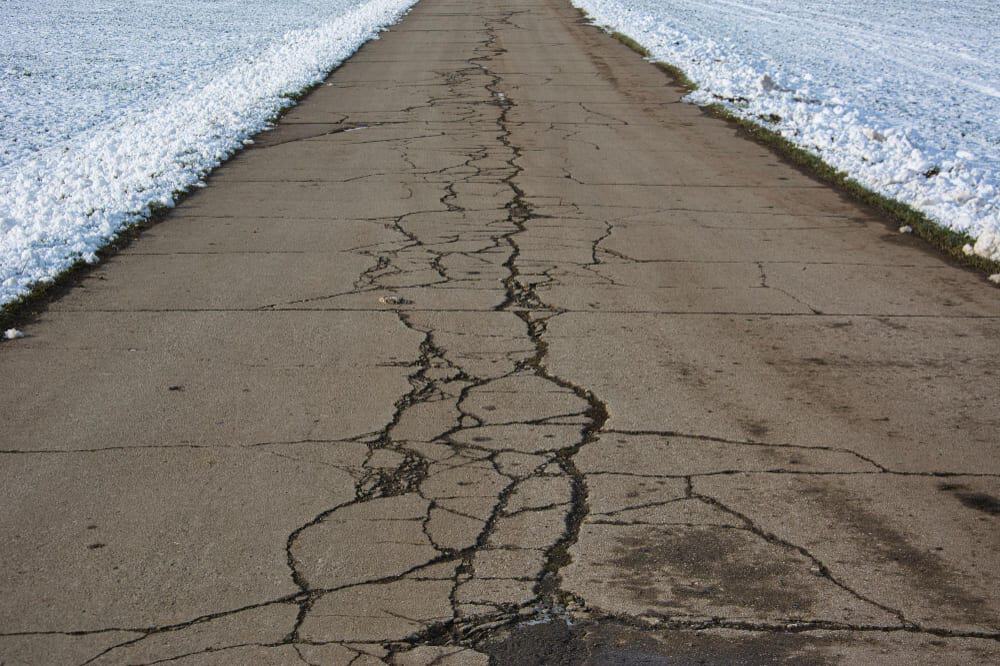
Fifty is a significant amount. That is fifty distinct rounds of expansion and contraction spread over a winter that begins to flirt with freezing in October and doesn’t fully let go until April, rather than a single severe freeze that tests a driveway once and moves on. Each of those cycles pushes any moisture that has gotten into a pore, crack, or weak spot in the sealer. A hairline crack turns into a real one because water expands by about 9% when it freezes, and asphalt has nowhere to direct that pressure except outward.
A properly cured seal can withstand such abuse. It’s designed to. The problem only arises when the seal was never given the opportunity to cure properly, which almost always stems from one factor: the temperature at which it was applied.
This is why driveway sealing advice that works in Georgia does not translate well to Ontario. The margin for error is smaller here, and missing it will result in an unplanned resealing job.

The temperature science behind driveway sealing
Sealer is not like paint that dries on a wall. It must cure completely, and this process is far more temperature-sensitive than most people expect.
Sealing contractors throughout Ontario consistently point to a surface temperature range of roughly 18 to 27 degrees Celsius as the true target, not just the air temperature but the actual surface of the asphalt, which on a sunny day can be significantly hotter than the air around it. Below that temperature, the sealer flows too slowly and can remain tacky for far longer than necessary, making it vulnerable to anything that touches it, including an overnight dip into frost. Push too far above that range, especially on a black driveway baking in the direct July sun, and the surface will dry too quickly on top while remaining soft underneath. That mismatch results in a film that appears finished but isn’t, and it deteriorates within the first year rather than lasting the two to four years that a proper seal should.
Along with that range, there is another number that is important to know. Most guidelines state that temperatures must remain above 10 degrees Celsius for at least 24 to 48 hours after application, day and night, not just during the warmest part of the afternoon. That overnight condition is the one that homeowners miss the most, because a 20-degree afternoon feels perfectly warm in the moment, even if the forecast predicts an 8-degree low that night.
A Mississauga homeowner discovered the truth the hard way after scheduling a crew for the first truly warm weekend in April, eager to finally get it done. The daytime high reached a comfortable 14 degrees. It seemed like a good day for the job. However, the temperature dropped to 2 degrees that night, and the sealer had not fully cured by the morning. A thin layer of ice had already begun to lift it at the edges, and what should have been a long-lasting seal required touch-up work within weeks.
That is the entire justification for waiting for a real window rather than a single favorable day. Late May through June is when the GTA tends to stay in the 18 to 27 degree range most consistently, both day and night, which is why that window keeps coming up in sealing advice rather than being an arbitrary seasonal preference.
The case for sealing in late spring
The most significant advantage of late spring is not just the temperature but also what a spring seal can do afterward. A driveway sealed in late May has the entire summer to cure before facing a freezing snap. By October, the film will have had months to fully harden, not weeks.
A few conditions worth checking before locking in a spring appointment:
- No standing water or rain in the previous 48 hours
- Daytime highs sitting reliably between 18 and 27 degrees
- Overnight lows nowhere near freezing
- No rain forecast for at least a day after the work is done
The tradeoff, if there is one, is that a spring seal is installed before the driveway has been subjected to a full summer of sun, heat, and traffic. Any damage that would have appeared over those months is not visible yet, which sometimes results in a minor issue being sealed over rather than repaired first. It’s a minor drawback in comparison to the temperature window’s reliability, but it’s worth noting.
You can see the full range of what’s included in a driveway sealing visit if you’re weighing whether spring is realistic for your schedule this year.
The case for sealing in early fall
If spring has already passed, early fall is a truly viable alternative, not just a consolation prize. September thru the first week or two of October makes a stronger case in one specific way: a driveway sealed in early fall receives protection right before the season that causes the most damage, rather than having to survive an entire summer first.
That is the appeal. The risk is that the window is noticeably narrower than in the spring. Ontario’s consistent warm weather typically ends by mid to late October, and a fall booking made too close to that date is a gamble on a forecast that can change quickly.
A property manager overseeing a commercial lot in Vaughan discovered the risk after the sealing date was pushed back to late October. The crew had to reschedule twice while waiting for a dry, mild stretch, and by the time conditions finally aligned, they had only a fraction of the margin September would have provided.
If fall is your goal, treat early to mid September as the true target rather than October. This provides a cushion in case a rainy week or an early cold snap causes delays.
Spring versus fall, side by side
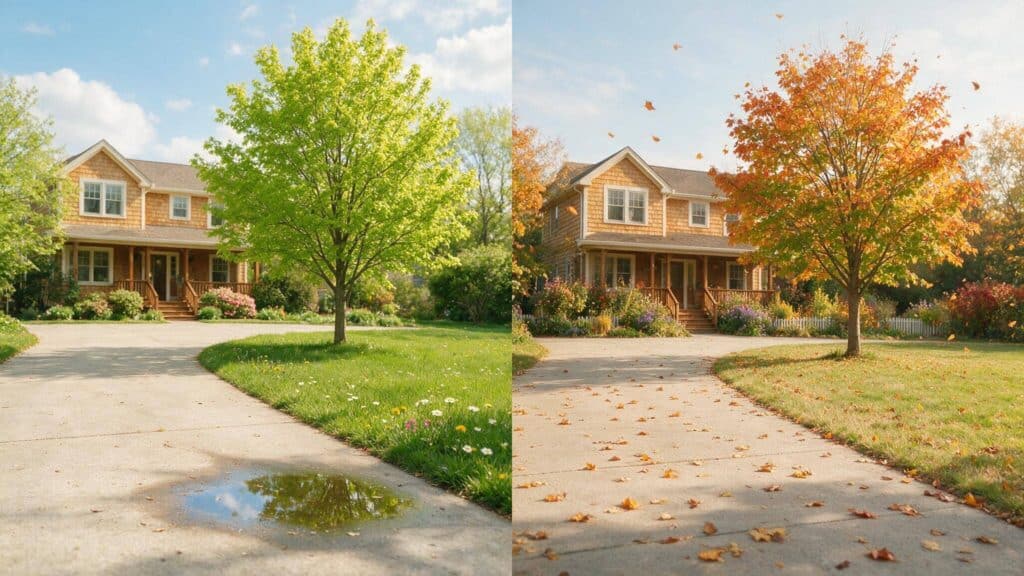
| Late spring (May to June) | Early fall (September) | |
|---|---|---|
| Temperature reliability | High, consistent window | Moderate, window closes fast |
| Cure time before winter | A full summer | Only a few weeks |
| Driveway wear visibility | Summer damage not visible yet | Full summer of wear already visible |
| Risk if the booking slips | Low | Higher, window is unforgiving |
Neither season is the wrong answer. What actually matters is picking one and booking inside the real window for it, rather than defaulting to whichever weekend happens to be free on your calendar.
Signs your driveway is actually due for sealing
Not every driveway requires regular sealing, and judging a driveway based solely on the color of the asphalt can be misleading. Most residential driveways last two to four years between sealing jobs, but this range varies greatly depending on how much sun the driveway receives, how much daily traffic it sees, and how much road salt accumulates on it during the winter.
Rather than sealing by the calendar, it’s worth actually checking the surface. A few reliable signs:
- The surface has faded from deep black to a dull, chalky gray
- It feels rough or slightly gritty underfoot instead of smooth
- Small surface cracks have started appearing, even hairline ones
- Water no longer beads on the surface and soaks in instead
- Individual pieces of aggregate are starting to poke through
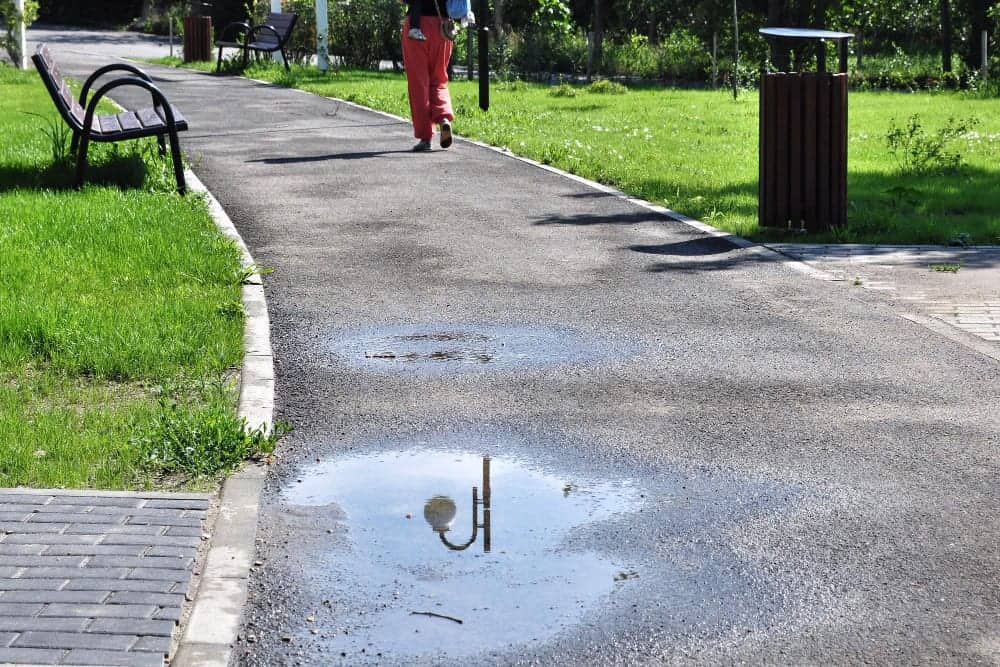
The last two points lead to the most basic test available, which costs nothing. Pour a small amount of water onto a dry area of the driveway. If it beads up and rolls away, the existing seal is still doing its job. If it absorbs within a few seconds, the protection is lost, even if the color appears relatively dark from a distance.
A Richmond Hill homeowner almost skipped resealing because the driveway had been done three years ago and still appeared mostly black from the street. A closer look during the quote visit revealed a different story. The surface had become slightly porous, and water that should have beaded was soaking directly in. Color was an incorrect criterion for making decisions. Texture conveyed the truth.
A different set of rules for a brand new driveway
Fresh asphalt operates under a different set of rules than an established driveway, and sealing it too soon is one of the most common, avoidable mistakes homeowners make immediately following a new installation.
Before new asphalt can properly accept a sealer, it must first offgas and settle. Locking a seal on top of it too soon traps the process beneath the film rather than allowing it to finish properly. The safest approach for a newly poured asphalt driveway is to wait a full year, including one complete winter. This allows the asphalt to fully cure and go through its first freeze-thaw cycle before anything is sealed on top of it.
Concrete is on an entirely different timeline. Fresh concrete should be cured for at least 28 days before any sealer can be applied. If you’re using a penetrating sealer in particular, most recommendations are to wait 60-90 days to ensure the concrete is fully dry all the way through, not just on the surface.
Mistakes that quietly undo a sealing job
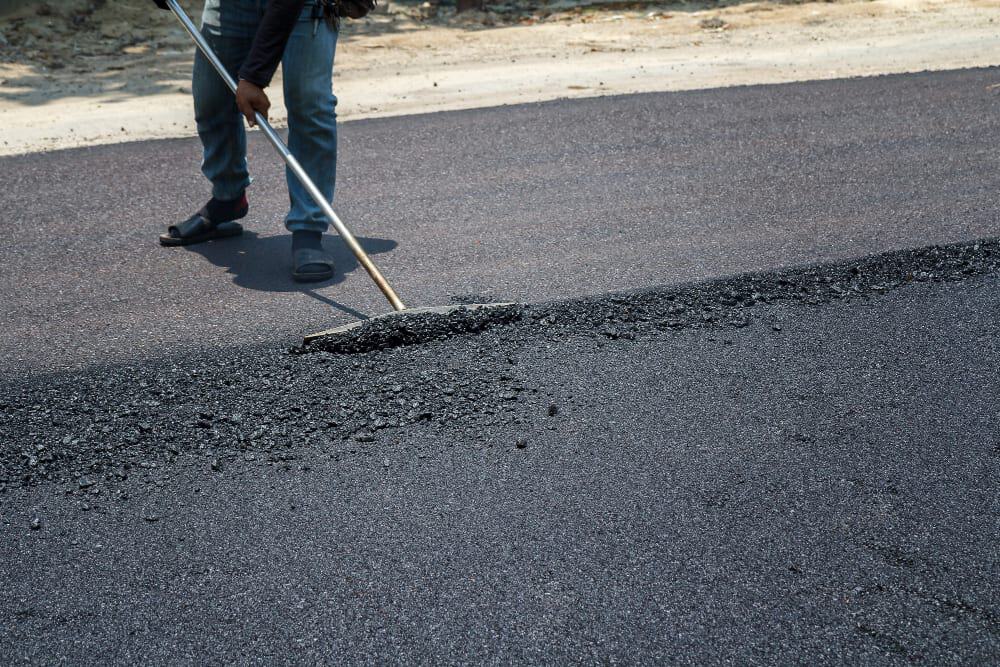
Most seal failures can be traced back to a decision made before the crew ever showed up, not to bad work on the day itself. A few patterns repeat again and again.
Booking around one warm day instead of a real window. A single 20-degree afternoon in the middle of a normally cool stretch feels like an opportunity, but a day is not a window. The next 24 to 48 hours, including the overnight lows that most people never think to check, will determine whether the job remains open.
Assuming the surface temperature matches the air temperature. A black driveway in direct sunlight can become significantly hotter than the air above it, which can have both positive and negative effects. It can push the surface into the too hot end of the range even on a mild day, or it can fool someone into thinking a marginal day is warmer than it is once the sun goes down.
Sealing over damage instead of repairing it first. A crack that is sealed over rather than cleaned and filled first still has moisture underneath it, which the freeze-thaw cycle will eventually detect. Sealer is a protective layer, not a repair solution.
A business owner in Ottawa ran into a version of this scenario after booking a parking lot sealing job for a warm Tuesday in late October, the only day that fit the crew’s schedule. The morning was forecast to be good. That night a cold front moved through that hadn’t been apparent a few days before, and overnight temperatures dropped long before the sealer had had time to cure. The lesson wasn’t that October is verboten; it’s that one day’s forecast isn’t enough to book against once you’re that close to the edge of the season.
The fix for all three is less about any particular trick and more about treating the appointment date as flexible until the extended forecast actually backs it up, instead of locking in a date weeks ahead and hoping the weather cooperates.
Frequently asked questions
Can I seal my driveway myself instead of hiring someone? You can, and many homeowners do. The biggest tradeoff is that DIY sealer is usually thinner and less durable than what professional crews apply, and nailing the temperature and timing without experience increases the odds of an uneven or short-lived result.
How long does a driveway need to cure before I can park on it? Most sealers need at least 24 to 48 hours before normal foot traffic and closer to 72 hours before vehicles are allowed back on them. Colder temps push that window out further.
Does the type of sealer change the ideal timing? A little. Asphalt emulsion sealers are more forgiving of temperature swings than coal tar-based products, but the core 18 to 27 degree guidance applies to the majority of the market.
What if my driveway already has cracks in it? Cracks should be cleaned and filled before applying sealer, not sealed over. Sealing over a crack traps moisture underneath rather than addressing the underlying issue.
Is it too late to seal if winter is close? If the forecast cannot reliably hold above 10 degrees for a few days after application, it is far better to wait until spring than to rush a job that will most likely not last the winter.
Do I need to seal a driveway every single year? No. Most residential driveways require resealing every two to four years. More frequent sealing provides no meaningful protection and only adds to the cost.
Getting it sealed at the right time
If there’s one takeaway from all of this, it’s that timing isn’t just a minor detail when it comes to driveway sealing; it’s what distinguishes a seal that lasts for years from one that needs to be redone by next spring.
The good news is that none of this requires guesswork once you know what to check. A real temperature window, a driveway that is truly ready for it, and a crew willing to wait for the right conditions rather than the most convenient afternoon will yield a result that will withstand everything a GTA winter can throw at it.
If your driveway is showing any of the signs covered above, or you’d just like someone to take an actual look and tell you whether this winter is the year to deal with it, Crest Property Care handles driveway sealing across the Greater Toronto Area and Greater Ottawa Area, scheduled around real forecasts rather than convenient booking slots. You can request a free quote online whenever it’s convenient.